
 Deutsch
 Español
 Français
 lingua italiana
 ไทย
 Tiếng Việt
 العربية
 한국어
 Pусский



Quick answer: Recheck an egg vending machine whenever a carton, sleeve, label, pack count or loading arrangement changes. Keep the old and new filled packs, identify the affected compartments or dispensing channels, test the complete purchase and collection journey, and record the results before releasing the changed package for sale. Matching outside dimensions alone does not establish that a new pack will work.
| Decide what to retest | Build the test record |
A farm may approve one carton during equipment selection and buy a different carton months later. A new pulp supplier, a taller lid, a promotional sleeve or a switch from six eggs to a larger pack can change how stock fits and how customers retrieve it. Treat that change as an operating decision, with a named owner and a dated record.
This guide explains a packaging change process for an existing or proposed egg vending installation. It does not prescribe a universal carton size, test count or storage temperature. Those depend on the actual equipment, final filled package, supplier instructions and local food requirements.
Compare the old and new package before loading
Measure finished, closed packs containing the eggs intended for sale. Include labels, bands, sleeves and any handle or closure that protrudes. Record the maximum outside length, width and height in the intended orientation, along with the filled weight. A catalog measurement of an empty carton may omit the part that catches on a door opening.
Place the old and new samples side by side. Check the lid profile, latch, base stability and surface, not just the three dimensions. Photograph both with their packaging revision or supplier reference. Keep a representative sample so the team can identify what was actually approved.
| Change | Why it matters | Focused check |
|---|---|---|
| New carton material, same stated size | Stiffness, friction and closure behavior may differ. | Compare the filled pack during loading and collection; inspect the lid and eggs afterward. |
| New label, band or promotional sleeve | An edge or loose flap may protrude beyond the carton. | Measure the final wrapped pack and watch for snagging at openings and transfer points. |
| More eggs or a different carton shape | Weight, height and the way a customer grips the pack change. | Review the assigned location, usable opening and full handling route with the supplier. |
| Different loading orientation or stock depth | A pack that fits alone may obstruct another pack or a door when stocked. | Test the agreed stocked arrangement and the last remaining pack. |
| New compartment or channel assignment | The tested location may have different clearances or settings. | Link the package approval to the exact location and configuration. |
Choose the test route for the machine you have
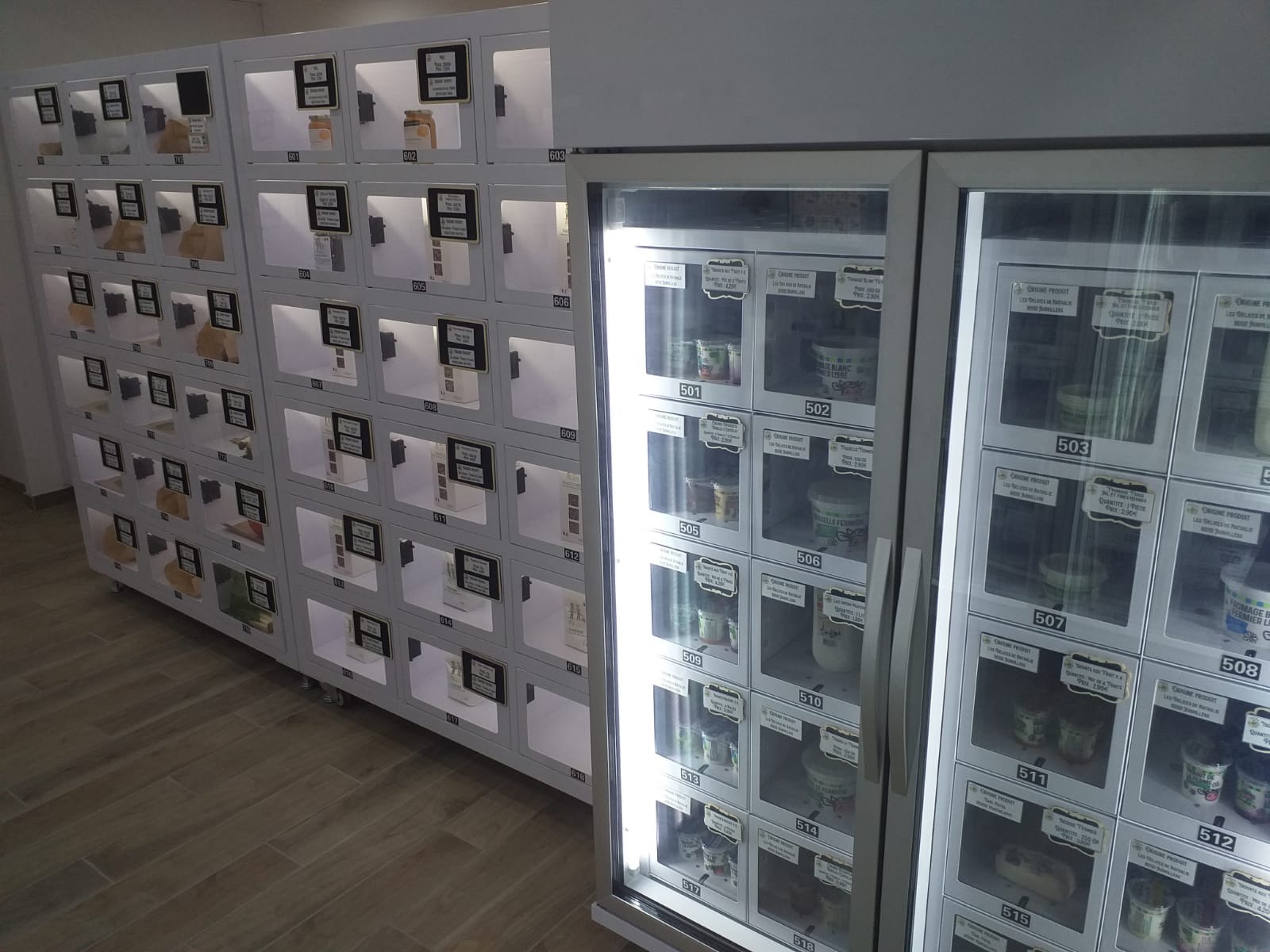
Locker: test the usable opening and normal hand collection
For a locker, compare the usable internal space with the clear door opening. Hinges, door edges and fittings may reduce the path available to the pack. Place the filled carton in its intended position, close the door normally, complete the authorized purchase or pickup procedure, and remove the carton without tilting it into an awkward grip or pulling on the lid.
Check the agreed number of packs per compartment. If two cartons are intended for one offer, test that exact arrangement and make the screen description match what the shopper receives. Do not stack stock simply because the nominal cabinet dimensions appear large enough.
Elevator or another dispensing route: follow the entire journey
A carton can fit its storage channel and still fail at transfer or collection. Ask the supplier to use the approved test procedure with the changed filled package, observing storage, release, transfer, movement and pickup. Record settings and any manual intervention. Keep hands clear of moving equipment; a test is not permission to defeat guards or reach into a mechanism.
Review the lowest-stock condition as well as the normal replenishment arrangement. Agree repetition and coverage with the equipment supplier before testing. Report the attempts and observed outcomes; a few successful trials do not establish a universal reliability rate.
Use a record that another operator can repeat
Assign a change reference before the first trial. One row per attempt is more useful than a final note saying "works." Record failures and corrections in the same file so the next operator can see why the loading arrangement changed.
| Record group | Fields to retain |
|---|---|
| Identity | Machine/site reference, date, operator, change reference and supplier contact. |
| Package | SKU, egg count, carton supplier/revision, filled dimensions and weight, photographs, sleeve or label version. |
| Configuration | Compartment/channel identifier, loading direction, stock arrangement and relevant approved settings. |
| Each attempt | Attempt number, starting stock, selection, observed delivery/door result, pickup result, package condition and intervention. |
| Disposition | Pass against agreed criteria, issue reference, correction, retest result, release owner and date. |
Write acceptance criteria before the test. Practical criteria can include the correct offer opening the intended compartment, the agreed quantity being available, normal collection without snagging, a closed undamaged carton and no visible egg damage attributable to handling. Define how you will inspect contents with the farm's food-handling procedure; do not return opened or compromised test stock to sale automatically.
If a trial fails, keep the affected offer unavailable using the supplier's approved controls. Describe what happened rather than assuming the cause. A raised lid, wrong location assignment and customer grip problem require different corrections. Repeat the affected checks after a correction and update the loading instructions.
Update the offer and the refill instructions together
A mechanical fit does not prevent a commercial mismatch. Check that the screen shows the correct pack count, product image, price and collection instructions. Reconcile the physical pack quantity with the inventory unit used by the operator. One compartment containing two cartons is not necessarily two separately sellable stock positions.
Remove superseded loading photographs from the refill guide and label the approved package revision. If old and new cartons coexist, give each a clear stock rule. Avoid an informal instruction to "use either" unless both arrangements have been reviewed.
Packaging approval also does not establish shelf life or a safe storage regime. Confirm storage, labeling, cleaning and sale requirements for the eggs and destination market separately. An equipment temperature range is not a universal legal storage instruction.
What to send Micron when a pack changes
The Micron smart egg locker describes customizable compartments and direct collection. Ask for the usable dimensions and proposed arrangement for your actual order rather than assuming an image represents every configuration. Micron and WEIMI share the same company identity; use the machine and order reference when requesting support.
Send photographs of the closed filled old and new packs, measurements, weight, intended quantity per sale, current compartment/channel map and the issue or change reference. Request confirmation of which clearances, settings and tests need review. After release, inspect early refill and collection observations and retain any incident reference with the change record.
Frequently asked questions
It may. Material, lid shape, stiffness, friction or a new label can change handling even when nominal dimensions match. Compare filled samples and review the affected route.
Measure the finished, closed pack containing the intended eggs and all sale packaging. Retain empty-carton specifications as supporting information rather than the sole fit evidence.
No. Check the usable door opening, fittings, loading position and space needed to grip and remove the pack normally.
Only after the proposed arrangement has been reviewed and tested for that compartment and offer. Make the pack count and price clear and align the stock record with the sale unit.
Agree coverage and repetitions with the supplier for the package, mechanism and risk involved. Record every attempt. This guide does not assign a universal count or claim that a small sample proves reliability.
Keep the affected offer unavailable, preserve the observation and inspect it using approved procedures. Correct the cause and repeat the relevant checks before releasing the configuration.
No. Mechanical fit and handling tests do not validate shelf life, food labeling or storage requirements. Resolve those separately for the product and destination market.
Yes. A sleeve, band or label can add thickness, a loose edge or a gripping obstruction. Include it on the filled sample and in the package revision record.
Review the new location and configuration first. Clearances, settings and the handling route can differ. Link any release to the locations actually covered by the tests.
Identify the machine, old and new package, loading arrangement, agreed criteria, attempts, outcomes, corrections and release owner. Include photographs and dated retest evidence so another operator can repeat the setup.
References
- Micron: Smart egg locker vending machine — company product configuration and direct collection information.
- WEIMI: Egg vending machines — finished-carton inputs and supplier selection context.
- Centrumo: Box vending machine for eggs — an example of model-specific compartment dimensions, not Micron specifications.
- Zhongda: Egg vending machine — package and delivery-route considerations in equipment selection.


